Understanding Smart Contracts: Self-Executing Code on the Blockchain
Smart contracts represent one of the most transformative applications of blockchain technology, enabling automated agreements that execute without intermediaries. This beginner-friendly guide breaks down how these digital agreements work and explores their real-world applications.
What Are Smart Contracts?
At their core, smart contracts are self-executing programs stored on a blockchain platform that automatically enforce the terms of an agreement when predetermined conditions are met. Unlike traditional contracts that require lawyers, notaries, or other intermediaries to interpret and enforce terms, smart contracts execute automatically based on code logic.
Think of a smart contract as a digital vending machine. When you insert the correct amount of money and press a button, the machine automatically dispenses your selected item without requiring a human operator. Similarly, when specific conditions written into a smart contract's code are satisfied, the contract automatically executes the agreed-upon actions.
The term "smart contract" was coined by computer scientist Nick Szabo in the 1990s, long before blockchain technology existed. However, it wasn't until the launch of Ethereum in 2015 that smart contracts became practical and widely accessible. Ethereum's blockchain was specifically designed to support these programmable agreements, providing a platform where developers could create decentralized applications.
What makes smart contracts particularly powerful is their combination of automation, transparency, and immutability. Once deployed on a blockchain, the contract code cannot be altered, and all transactions are permanently recorded and visible to network participants. This creates a trustless environment where parties can engage in agreements without needing to trust each other or rely on third-party enforcement.
How Smart Contracts Work: The Technical Foundation
Smart contracts operate through a series of logical steps that mirror traditional contractual agreements but execute automatically through code. Understanding this process helps demystify how these digital agreements function on blockchain platforms.
The process begins when a developer writes the contract code, typically using specialized programming languages like Solidity for Ethereum. This code defines the rules, conditions, and actions that will govern the agreement. For example, a simple smart contract might state: "If Party A sends 10 tokens to this contract address, then automatically transfer ownership of Digital Asset X to Party A."
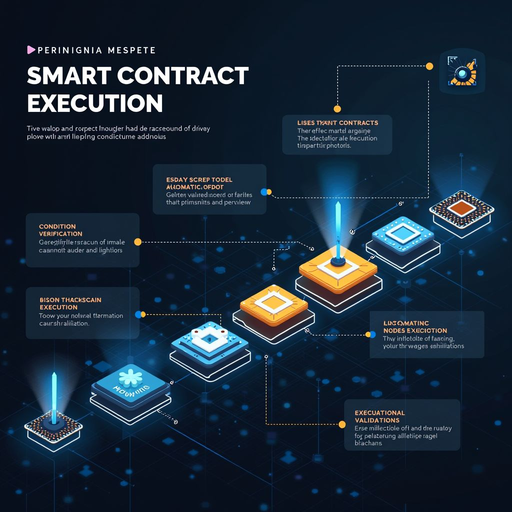
Once written, the contract is deployed to the blockchain network. This deployment process involves broadcasting the contract code to the network, where it's verified by nodes and assigned a unique address. From this point forward, the contract exists permanently on the blockchain and can be interacted with by sending transactions to its address.
When someone initiates a transaction that triggers the smart contract, the blockchain network's nodes execute the contract code. These nodes independently verify that the conditions specified in the contract have been met. If the conditions are satisfied, the contract automatically executes the programmed actions, such as transferring digital assets, recording data, or triggering other contracts.
The execution results are then recorded on the blockchain as a new transaction, creating a permanent and transparent record of the contract's activity. This entire process happens without human intervention, ensuring consistency and eliminating the possibility of selective enforcement or interpretation disputes.
Key Features That Make Smart Contracts Powerful
Smart contracts possess several distinctive characteristics that differentiate them from traditional agreements and make them particularly valuable for certain applications. Understanding these features helps explain why organizations are increasingly exploring smart contract technology.
Automation and Self-Execution
The most fundamental feature of smart contracts is their ability to execute automatically when conditions are met. This automation eliminates the need for intermediaries to interpret terms, verify compliance, or enforce execution. The contract simply runs its code when triggered, reducing delays and removing potential points of human error or bias.
Transparency and Verifiability
Smart contracts operate on public blockchains where their code and execution history are visible to all network participants. This transparency allows anyone to verify exactly what a contract does before interacting with it. All parties can independently confirm that the contract will execute as specified, building trust without requiring faith in any single entity.
Immutability and Security
Once deployed, smart contracts cannot be altered or deleted. This immutability ensures that the terms agreed upon at deployment remain unchanged throughout the contract's lifetime. While this characteristic provides security and prevents tampering, it also means that bugs or vulnerabilities in the code cannot be easily fixed, making thorough testing before deployment critical.
Cost Efficiency
By removing intermediaries and automating execution, smart contracts can significantly reduce transaction costs. There's no need to pay lawyers to draft agreements, notaries to witness signatures, or escrow services to hold funds. The blockchain network itself provides these functions through code execution and cryptographic verification.
Real-World Applications: Supply Chain Tracking
One of the most practical applications of smart contracts is in supply chain management, where they provide transparency and automation for tracking goods as they move from manufacturers to consumers. This use case demonstrates how smart contracts can solve real business problems while improving efficiency and trust.

In a traditional supply chain, tracking products requires coordination between multiple parties, each maintaining their own records. This fragmentation creates opportunities for errors, delays, and disputes. Smart contracts address these challenges by creating a single, shared source of truth that all parties can access and trust.
Consider a simple example: A manufacturer produces goods that must pass through a shipping company before reaching a retailer. A smart contract can be programmed to automatically release payment to the manufacturer when the shipping company confirms receipt of the goods, and then release payment to the shipping company when the retailer confirms delivery. Each step is recorded on the blockchain, creating an immutable audit trail.
The contract might include conditions such as temperature requirements for perishable goods or time limits for delivery. If sensors detect that refrigerated items exceeded safe temperature thresholds during shipping, the smart contract could automatically adjust payment or trigger insurance claims. This level of automation and conditional logic would be extremely difficult and expensive to implement using traditional systems.
Major companies have begun exploring these applications. For instance, some food producers use blockchain-based smart contracts to track products from farm to table, allowing consumers to verify the origin and handling of their food. This transparency helps build consumer trust while giving companies better visibility into their supply chains.
Digital Identity Verification: A Growing Use Case
Another promising application of smart contracts involves digital identity verification, where they can help individuals control their personal information while enabling secure authentication for various services. This use case addresses growing concerns about data privacy and identity theft in our increasingly digital world.
Traditional identity systems require individuals to repeatedly share sensitive personal information with different organizations, each maintaining their own database. This creates multiple points of vulnerability where data breaches can occur. Smart contracts offer an alternative approach where individuals maintain control over their identity credentials while selectively sharing verified information as needed.

In a smart contract-based identity system, verified credentials such as age, citizenship, or professional qualifications are stored on the blockchain. When a service needs to verify one of these credentials, a smart contract can confirm the information without revealing unnecessary details. For example, a smart contract could verify that someone is over 18 years old without disclosing their exact birthdate or other personal information.
This approach gives individuals greater control over their data while reducing the burden on organizations to store and protect sensitive information. The smart contract acts as a trusted intermediary that can verify claims without requiring direct access to underlying personal data. Organizations can trust the verification because it's cryptographically secured and recorded on the blockchain.
Several governments and organizations are piloting blockchain-based identity systems. These projects explore how smart contracts can streamline processes like passport verification, professional licensing, and educational credential verification while enhancing privacy and security. Though still in early stages, these applications demonstrate the potential for smart contracts to reshape how we manage digital identity.
Understanding the Limitations and Challenges
While smart contracts offer significant advantages, they also face important limitations that affect their practical application. Understanding these challenges provides a more balanced perspective on the technology and helps set realistic expectations for what smart contracts can achieve.
The most significant challenge is the "oracle problem" – smart contracts can only access data that exists on the blockchain, but many real-world applications require information from outside the blockchain. For example, a smart contract that releases insurance payments based on weather conditions needs reliable weather data. Connecting smart contracts to external data sources requires trusted intermediaries called oracles, which somewhat undermines the trustless nature of the system.
Code immutability, while providing security benefits, also creates risks. Bugs or vulnerabilities in smart contract code cannot be easily fixed after deployment. Several high-profile incidents have demonstrated this risk, where flaws in smart contract code led to significant losses. This makes thorough testing and security audits essential before deploying contracts, adding time and cost to development.
Scalability remains another concern. Executing smart contracts requires computational resources from blockchain networks, and as usage increases, networks can become congested and transaction costs can rise. This limits the types of applications that can economically use smart contracts, particularly for high-frequency or low-value transactions.
Legal and regulatory uncertainty also poses challenges. Traditional legal systems are built around human-readable contracts and established precedents for interpretation and enforcement. Smart contracts operate in code, raising questions about legal recognition, liability when things go wrong, and how disputes should be resolved. These questions are gradually being addressed, but the legal framework for smart contracts remains evolving.
Looking Forward: The Future of Smart Contracts
Smart contracts represent a fundamental innovation in how agreements can be structured and executed in the digital age. By combining automation, transparency, and cryptographic security, they offer solutions to longstanding problems in coordination and trust between parties who may not know each other.
The technology continues to evolve rapidly. Developers are working on solutions to current limitations, such as improved oracle systems for connecting to external data, layer-2 scaling solutions to reduce costs, and formal verification methods to catch bugs before deployment. These improvements will expand the range of practical applications for smart contracts.
As the technology matures and regulatory frameworks develop, we're likely to see smart contracts integrated into more mainstream applications. From automating insurance claims to streamlining real estate transactions, the potential applications span numerous industries. However, success will depend on addressing current limitations while building systems that are secure, user-friendly, and legally sound.
For individuals learning about blockchain technology, understanding smart contracts provides insight into one of the most practical applications of decentralized systems. These self-executing agreements demonstrate how code can create trust and enable coordination in ways that weren't previously possible, opening new possibilities for how we structure digital interactions and agreements.
Whether smart contracts will revolutionize every aspect of digital agreements remains to be seen, but they've already proven valuable for specific use cases and continue to inspire innovation in how we think about automation, trust, and coordination in the digital economy.